
coaches corner
Welcome to the Orem Recreation Coaches Corner, your primary resource for leading a youth team this season. Whether you’re a seasoned pro or a parent volunteer, this page provides the essential tools, safety requirements, and practice tips you need to succeed. Thank you for stepping up to mentor our athletes and help them build skills that last a lifetime.
Are you interested in volunteering to coach?
The Orem Recreation Department utilizes volunteers as youth coaches. These volunteers are often a parent of one of the participants on the team – but having a child on the team is NOT a requirement. A typical scenario has mom or dad registering their kid, and being asked to volunteer as a coach.
Oftentimes, a parent will even sign up to be an assistant coach and then find themselves named the head coach because no other parents volunteered. However you were selected to coach, thank you for being willing to help out.
Did you know . . . coaches are one of the most influential people in the lives of athletes. They have the opportunity and the responsibility to teach valuable lessons that can impact the development of a child… for a lifetime.
If you are interested in volunteering as a youth sports coach, please call us: 801 229-7154
Background Check required
Please click on this link to fill out a background check.
What you can expect from us
- Trained staff (supervisors, officials & score keepers) – but they aren’t professionals!
- Fairness & consistency
- Support of coaches
- Safety first mentality
- Concussion Awareness Training
- Pre-Season coach’s meeting
What we expect of you
Make sportsmanship your #1 priority. “One person practicing sportsmanship is far better than a hundred teaching it.” Knute Rockne
Treat game officials with respect at all times
Zero tolerance for disrespectful behavior
Weekly practices teaching fundamental skills
Report suspected concussions to Recreation Staff
MANY FIRST-TIME COACHES FIND THIS ROLE HARDER THAN THEY EXPECTED, SO HERE ARE A FEW TIPS TO EASE MATTERS AND HELP YOUR YOUTH ATHLETES.
BEFORE THE SEASON
Contact each kid (or their parent) on your team as soon as possible. These kids are anxious to get started! Communicate effectively throughout the season. Text, email, whatever . . . just make sure that everyone knows about games, practices, team pictures, etc. And make sure everyone has your contact info as well.
PARENT'S MEETING
Begin the season with a parents’ meeting. This meeting doesn’t have to be formal – gather at the end of a first practice if that works.
- Introduce yourself
- Emphasize the importance of sportsmanship! After emphasizing sportsmanship at the pre-season meeting, discuss it every single week so everyone knows that sportsmanship is a priority. Expect it from everyone at practices and games and then acknowledge examples of good sportsmanship – or even better, ask the kids to point out the good examples. As the coach, set the standard – be the example! One person practicing sportsmanship is far better than a hundred preaching it.
- Review the league rules and any specific team rules you might have.
- Discuss schedule (games and practices, which are typically held once a week). Hand out copies of the game schedule or email copy/link later. Also distribute picture packets.
- Review what equipment will be needed for practices and games. Share when and how they’ll get the uniforms.
- Concussion review
- Share Expectations: What can players and parents expect from you? What do you expect of players and parents?
- Recruit the parents to help. One adult should NEVER be alone with the kids. Furthermore, it often helps to have some parents pitch in at practices and games. If you invite them directly, they will likely support you with a few extra hands. Getting them involved at your practices also makes it more likely they’ll be comfortable practicing the sport with their child outside of official practice time.
practices
- Welcome each player by name at every practice and game. When kids arrive to coaches who are smiling and greeting them by name, they feel welcome and positive from the start.
- Plan practices that keep kids active. When kids are moving and active, they are more likely to stay focused. At the younger ages, avoid lines. Bring plenty of equipment, so kids are not standing around waiting for their turn. Find games/drills that give kids a lot of repeated practice of the skills. Additional help at practices will assist in keeping the kids active. Consider having “stations” where a different skill is taught at each one and the kids will rotate through the various stations.
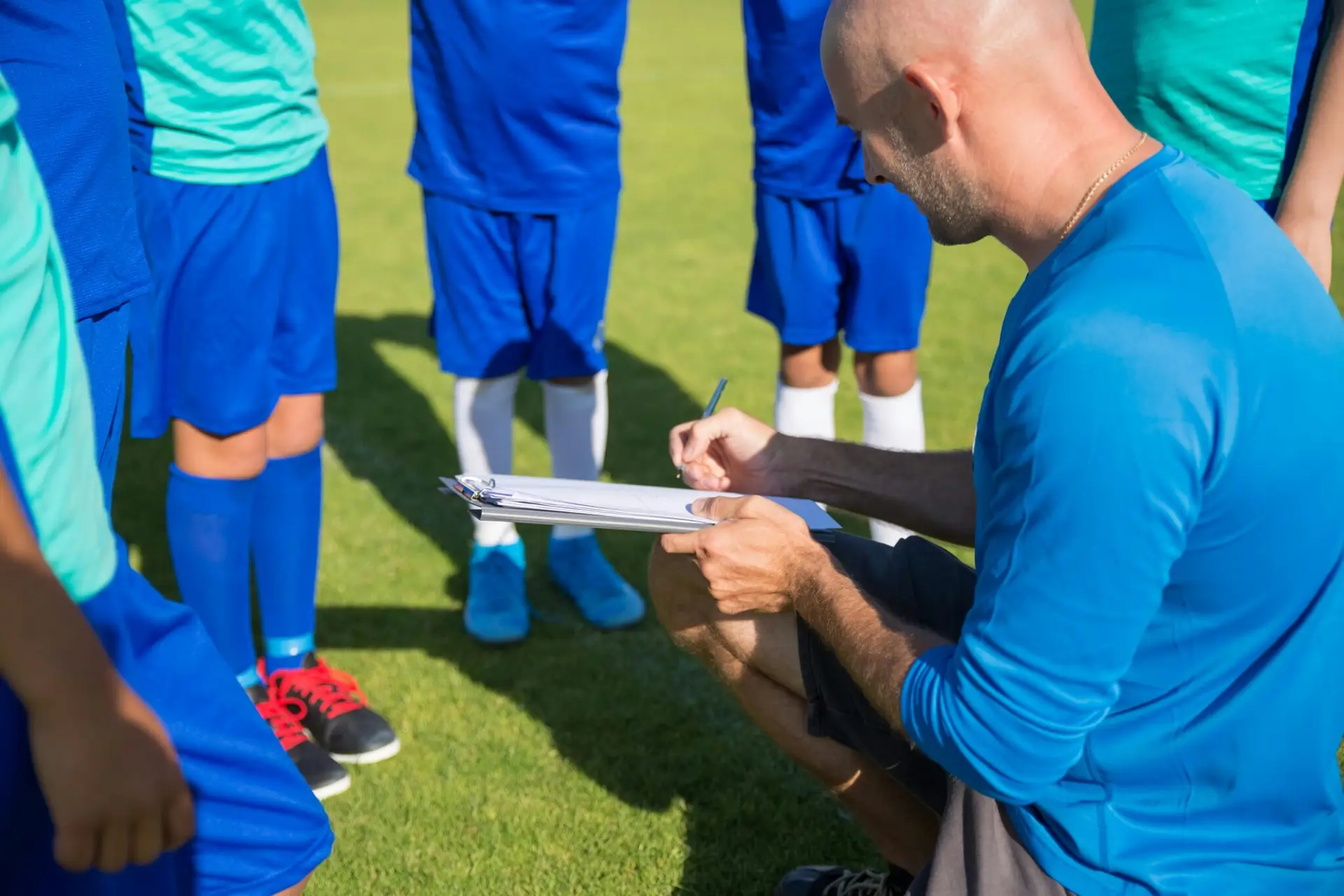
- Be brief! Six 60-second conversations with your players at a practice are much better than two 5-minute conversations! Make the most of the 30-60 seconds you’ve got their attention! A suggestion: when you’re talking to your athletes, get onto their level (at least physically!) by taking a knee, so you can (literally and figuratively) see eye-to-eye. And be positive!
- Pick 1-2 areas of focus per practice/game. You likely only have one hour for your practice. Pick one topic (two at the most!) to introduce and repeat over and over again. At the start of practice you might say, “Today is going to be all about passing.” Then each time you bring the players in, ask them, “What is our focus today?” Then have this same focus for your competition that week. Whenever you see it being executed well, let your players know it, “Milo, awesome pass to Nathan!”
- End practices/games on a positive note. At the end of practice or a game, call in all of the athletes and the parents. Ask the kids: “Who saw one of your teammates do something well?” The kids are actually good at answering this question. Then ask the parents, “Parents, what did you see that you liked?” This gives the parents a nice chance to recognize specific, positive things they saw, and it ends the practice/competition on a high note. This would be a great time to review sportsmanship and identify those who exemplified it.
Resources for coaches
Code of Conduct
Concussion Policy
Utah Code § 26B-4-401 et seq. requires all amateur sports organizations to adopt and enforce a concussion and head injury policy. The City of Orem (City) recognizes that concussions and head injuries can result from contact in sports and have serious consequences if not properly evaluated and treated. Therefore, consistent with state law, the City has adopted its Concussion and Traumatic Head Injury Policy (Policy) in order to educate and to establish a plan of action for coaches, teachers, employees, representatives, or volunteers of the City (Agents) when a player (defined as an individual under the age of 18 years) suffers or is suspected of suffering a concussion during a sporting event.
How Teams are Formed
Find Your Team For Youth Sports
Youth Sports teams are formed by administrative staff. They use your home’s geographical location as a basis for forming teams. Orem is split into youth recreational sports boundaries, which are also called grids. Your child is guaranteed to be on the same team as other participants who sign up from the same grid.
Find your grid by clicking the link below and using the “I want to” button to find your address. Those children in the same grid area (i.e. grid 29) will be on the same team.
We do not accept requests. However, there is one exception to this rule. If your child attends a school other than the neighborhood school where you live, he or she may request to play on a team at the school he or she attends, rather than with kids who live in your neighborhood grid. You must make this request on behalf of your child before registration ends.
Call us: 801 229-7154 to make this request.
Sometimes, a grid may not have a full team because not enough participants signed up. In this case, neighboring grids are combined.
Which grids are combined differs from year to year and depends on how many participants are signed up in each one. The decision to combine grids is up to administrative staff.
Once teams are formed, participants will not be transferred.